Loop Marketing Deep-Dive for Small Businesses
Key Takeaways
- Loop marketing is a four-stage framework developed by HubSpot. It combines human judgment, AI, and customer feedback to help small teams Express what makes their business distinctive, Tailor their message to different buyers, Amplify it across relevant channels, and Evolve based on what they learn.
- Loop marketing helps small businesses make better use of limited time and budgets by turning one useful asset into material for several buyer touchpoints, such as a LinkedIn post that introduces a problem and a sales follow-up email that helps a prospect evaluate a solution.
- A Taste Profile captures your brand’s voice, values, perspective, ideal customer, and insights from customer interactions so your team and its AI tools can create content that reflects your expertise and answers real buyer questions.
- Start with one measurable business goal and one asset that helps buyers take the next step. Use the channels you already have and decide before launch how you’ll measure progress.
- Track outcomes such as qualified assessment calls or demo bookings. If lead volume is low, use recurring questions from sales conversations to decide what to test next.
Intro
AI makes it easier for small businesses to produce blog posts, emails, and social content. It also makes it easier for competitors to publish similar advice. When buyers can find dozens of similar answers, the details that make your business credible matter more. A specific point of view, a useful example, or an answer drawn from firsthand experience can give them a reason to pay attention.
Loop marketing is HubSpot’s four-stage framework for turning that expertise into campaigns that improve as you learn. It combines human judgment, AI-assisted execution, and customer feedback to help you decide what to say, where to share it, and what to change next.
Those decisions matter because buyers can discover and evaluate the same business in different ways. They might find you through a search, hear about you from a colleague, or ask an AI assistant to compare their options. A referral might put a consultancy on a buyer’s shortlist, while a case study helps them decide whether to get in touch. A software buyer might first see the product in a walkthrough, then look for evidence that it fits their team’s workflow.
For a small team, the practical question is where to put its next hour or dollar when a channel becomes less reliable. One place to start is with the questions buyers already ask. Use them toshape a campaign, then look at which messages and resources help people take the next step. The results give you a basis for deciding where to spend your time next.
This guide walks through all four stages and shows how to run your first Loop around one business goal, using the tools and customer insights you already have.
What Is Loop Marketing?
Loop marketing is a four-stage marketing framework that combines human strategy and creativity with AI-assisted execution, personalization, and optimization. It gives each campaign a second job. Alongside generating interest or inquiries, the campaign helps you learn what buyers need to see, hear, or understand before they take the next step.
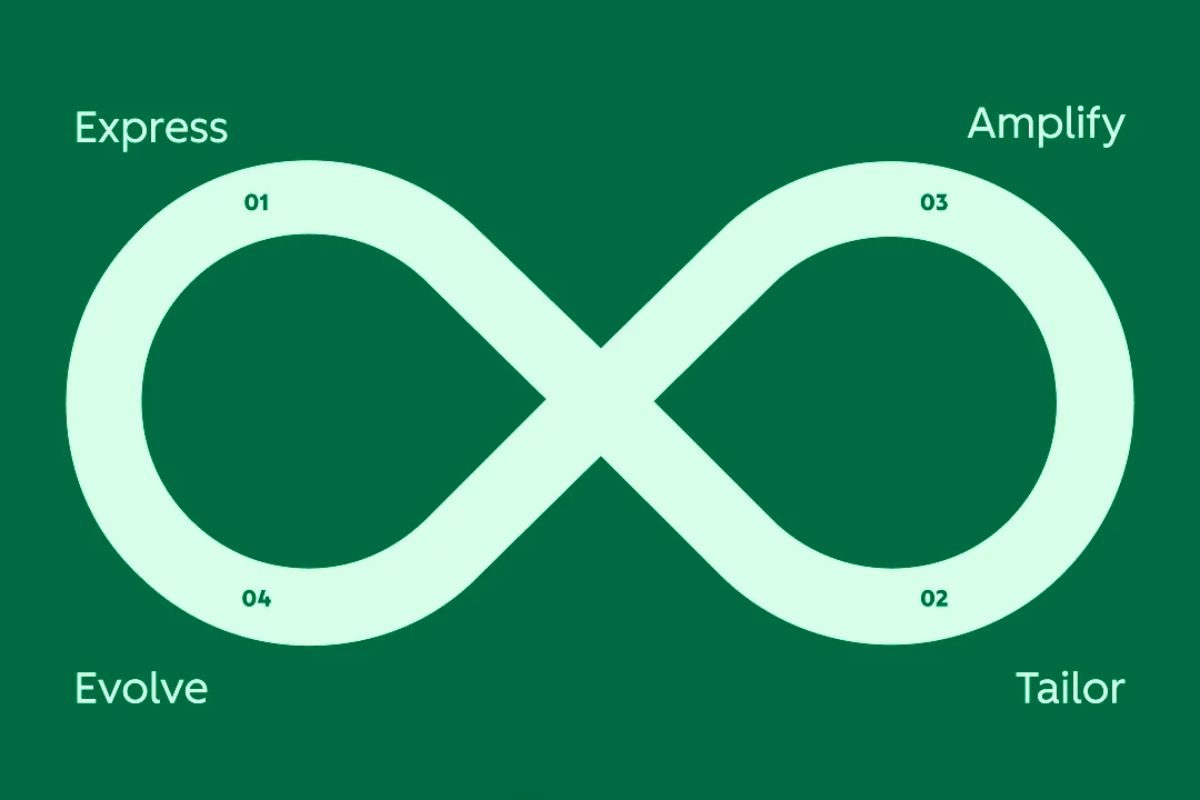
The Loop marketing framework, designed by HubSpot, consists of four stages: Express your story, Tailor your messaging, Amplify your reach, and Evolve in real time.
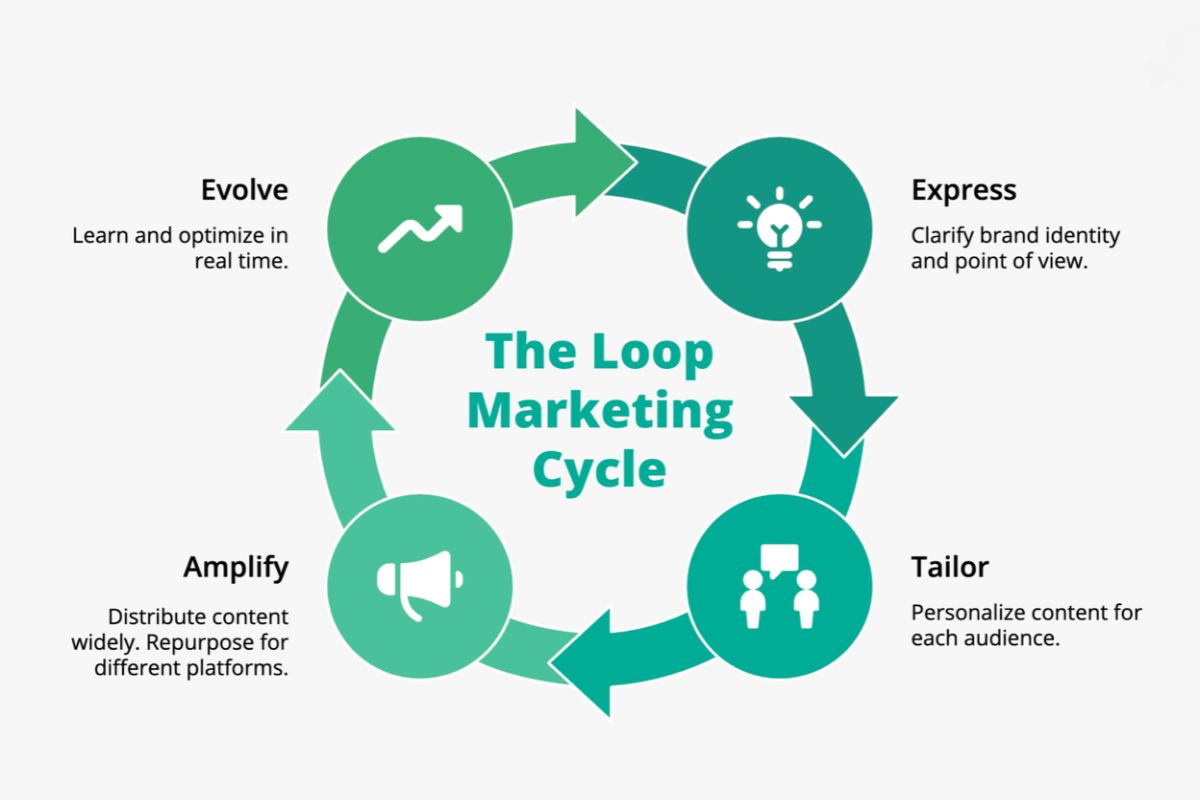
In Express, you define what makes your business distinctive and why it matters to the customers you want to reach. In Tailor, you adapt the message to the questions different buyers bring. In Amplify, you share it where those buyers already look for answers. In Evolve, you use campaign results and customer feedback to decide what to adjust during the campaign or test in the next one.
Instead of repeatedly starting from scratch, Loop marketing allows you to build on what you have already learned. An operations consultancy, for example, might publish a guide to diagnosing project delays and share it on LinkedIn and in sales follow-ups. If several prospects read the guide but ask what they would get from an initial assessment, the firm has a specific change to test. It could add a sample assessment deliverable to the page and track whether more qualified prospects book a call.
A Taste Profile gives your team and its AI tools a shared reference for what makes your business distinctive and what your customers care about. It gives AI the context it needs to create content that reflects a specific brand’s voice, values, and perspective instead of producing generic copy.
For the consultancy, that could include the language clients use to describe project delays, the questions its consultants ask before recommending a fix, and examples that show how the firm works. Those details help the team brief new content without asking a founder to explain the firm’s approach from scratch each time.

Why Does Loop Marketing Matter for Small Businesses?
Traditional marketing funnels help businesses understand how customers move from awareness toward conversion. However, when marketing activities are managed as separate campaigns, it can be difficult and time-consuming to carry insights from one campaign into the next.
Loop marketing gives small teams a way to carry those insights forward. A question from a sales call can shape the next article. An article that helps prospects evaluate a service can become a resource the sales team shares before a call. Each piece of work gives the team something to build on, which matters when the same few people are responsible for attracting leads, following up, and serving customers.
For an established consultancy that relies on referrals, this is a way to make its expertise visible beyond its existing network. An operations firm could turn a recurring client problem into a diagnostic guide that prospective buyers can find and use on their own. Business development can also share it with prospects who are still defining the problem. The firm gets more use out of expertise it already has, and prospects get a sense of how the team thinks before they book a call.
Loop marketing also helps in creating more relevant customer experiences by adapting to the changing buyer behaviour. A small SaaS company, for instance, might hear different questions about the same workflow tool. An operations lead wants to know whether it will cut the time spent chasing approvals. The person signing off on the purchase wants to know how much work it will take to roll out. Using those questions to shape the product page and demo follow-up gives each buyer a clearer reason to move forward.
The framework also helps small teams decide where to spend their time. A buyer might discover the consultancy through a referral, look up its approach, and read a case study before reaching out. A software buyer might find the product in an AI-generated shortlist and watch a walkthrough before booking a demo. Each touchpoint can answer a different question. Start with the places buyers already use, then look at which resources help turn interest into qualified conversations.
This doesn’t necessarily mean that the traditional marketing funnel is obsolete, but the buyer’s journey is no longer confined to a linear path, and organizations’ marketing strategies need to reflect that.
The Four Stages of Loop Marketing
Loop marketing consists of four stages: Express, Tailor, Amplify, and Evolve. Let’s take a look at each of them and how they work.
1. Express Your Story
The first stage of Loop marketing is Express, which sets the tone for everything else. Before using AI to create content or launching another campaign, you need a clear understanding of your audience, value proposition, brand voice, and competitive differences. Without that foundation, AI-generated content can easily become generic and go unnoticed.
Focus on defining what to say, why it matters, and how it addresses your customer’s immediate challenges. Having a well-developed Taste Profile is crucial for this step, because it brings together information about your business and customers to guide your marketing. Start with three questions. What problem makes your ideal customer look for help? What do you understand about that problem that shapes how you solve it? What can you show to back up your approach?
You can also use AI to analyze existing customer reviews, feedback, and sales conversations to identify recurring questions, concerns, and potential gaps in your messaging. For a small team, a short interview with a founder or subject matter expert, a relevant client case, and notes from a few recent sales calls are enough to build a first version. Ask the expert to review the profile so the team can reuse their input across briefs and drafts.
Take the operations consultancy from earlier. Prospects often describe the same problem on sales calls: “Everyone’s busy, but projects still miss deadlines.” The founder explains that the firm starts by tracing where work waits for decisions or gets sent back for revisions. A recent engagement gives the team a concrete example of how that diagnosis works. The Taste Profile could capture those inputs like this:
- Ideal customer — An operations leader dealing with repeated project delays who needs to know where work gets stuck.
- Point of view — Before recommending more staff or a new tool, trace where decisions stall and where work has to be done twice.
- Voice and proof — Use plain language and real examples. Show what the team looked at, what it found, and how that finding shaped its recommendation.
With that profile in the brief, AI can help draft a guide that shows readers how to spot a stalled handoff or approval. The team can check the draft against the client case, and the founder can focus their review on whether the guide reflects how the firm actually works.
2. Tailor to Your Audience
Once you understand your brand and audience, the Tailor stage helps you make your messaging more relevant to different customer needs. Different customers may be interested in the same product for different reasons. Even two people evaluating the same purchase can have different questions. Start with the questions you already hear in sales calls, demos, or customer conversations. Those can tell you where a single version of your message leaves buyers guessing.
AI can help you adapt content, brainstorm variations, or repurpose existing material for a different customer segment. The goal is to address your customers’ actual needs and interests. Give AI your Taste Profile, the core asset, and the question each version needs to answer. That way, you can change the emphasis while keeping the underlying advice and evidence consistent.
Take the operations consultancy’s guide to diagnosing project delays. An operations lead wants to know where work gets stuck, so one version could lead with a checklist for spotting stalled approvals and handoffs. An executive sponsor wants to know whether the delays warrant outside help, so another version could lead with a worksheet for estimating the cost of missed deadlines and rework. Both draw on the same diagnostic method, but each helps its reader make a different decision.
The same principle applies to SaaS. A workflow software company could use the same product walkthrough to show a team lead how to spot overdue approvals and show an IT lead how to configure permissions. The product stays the same. What changes is what each buyer needs to see before they can move forward.
3. Amplify It Across Channels
Creating great content has limited value if the right people never see it. The Amplify stage focuses on distributing content across relevant channels, including your website, email, social media, partnerships, and other places where your audience might look for information. It also considers how people discover businesses through AI-powered search and answer engines.
For a small team, start with two or three places where buyers already discover or evaluate your business. Give each channel a job. A LinkedIn post might help someone recognize a problem, while a sales follow-up email can give a prospect something useful to share with the person who approves the budget.
Take the operations consultancy’s guide to diagnosing project delays. The firm can publish the full guide on its website, then have the founder share one diagnostic question on LinkedIn: “Where does work sit the longest while it waits for a decision?” The business development team can send the cost worksheet from the Tailor stage to prospects who need to make the case for an assessment internally. All three assets support the same goal of generating qualified assessment calls, and each gives the buyer a useful next step.
Answer Engine Optimization (AEO) is also worth considering as part of your distribution strategy, as people increasingly use AI assistants and answer engines to find products and compare services. For the consultancy, that could mean answering “How do I tell whether slow approvals are causing project delays?” directly in the guide. The firm could show readers how to compare the time a task spends waiting for approval with the time people spend working on it, then illustrate the difference with an example from a client engagement.
Finally, targeted advertising and partnerships with creators or subject matter experts can help you reach relevant audiences through channels and voices they already trust. For example, the consultancy could walk through the checklist in a webinar hosted by an operations association whose members face the same problem.
4. Evolve Your Strategy
The fourth stage, Evolve, turns your marketing activities into learning and improvement opportunities. Start with the outcome your campaign was designed to support, then look at what buyers did and what they told you. Page visits and clicks can show where people are paying attention. Inquiry details and sales conversations can help you understand whether you’re reaching the right buyers and what’s holding them back.
For a small team, a weekly review can be enough to catch a recurring question or spot a problem worth investigating while the campaign is running. If lead volume is low, treat a few similar questions as a reason to test a change. Review the quality of the next inquiries alongside the numbers before deciding whether to keep it. Depending on your tools and the volume of data available, AI may help speed up this analysis, but the decisions should still be guided by reliable evidence and human judgment.
Suppose the operations consultancy’s guide draws readers, but few book an assessment call. In follow-up conversations, several prospects ask what the assessment actually delivers. The firm could add a redacted sample showing where a client’s work was getting stuck and what the team recommended. It could then track how many readers book a call, how many of those prospects fit the service, and whether the same question still comes up.
Evolve completes the Loop, as the insights gathered here flow directly into any other stage that might need adjustment. In this case, the feedback points back to Tailor. The consultancy can use the sample to answer the same question in its sales follow-up email, giving prospects something concrete to share with the person who approves the engagement.

How to Get Started with Loop Marketing
Understanding Loop marketing is one thing, but putting it into practice can be challenging. You don’t need to change your entire marketing strategy overnight or strictly follow the four stages. Start with one problem you can investigate using the tools and customer feedback you already have.
Take a small workflow software company. Its website attracts visitors, and existing customers use the product to manage purchase approvals, but few of the right buyers book a demo. The team can run its first Loop around that single use case.
Choose One Business Goal
Decide what you want your marketing to achieve. Avoid vague objectives such as becoming more visible or improving engagement without defining what those outcomes mean for your business. Where possible, establish a baseline and set a measurable target with a realistic timeframe.
The SaaS team could aim to increase qualified demo bookings from companies that currently manage purchase approvals through email or spreadsheets. Before setting a target, it reviews how many such bookings it received in the last month and agrees with sales on what counts as qualified.
Build Your Taste Profile
Document the information AI needs to understand your business, such as your ideal customer, positioning, brand voice, main services, differentiators, and common customer questions. For this campaign, the SaaS team can start with recent demo notes and a customer example. If prospects repeatedly ask how the software handles approvals when a manager is away, the team can record that question in the buyer’s own words alongside the verified answer and an example from the product.
Create One Core Campaign Asset
Build one asset that answers a question buyers need resolved before they take the next step. The SaaS team could create a purchase approvals page that walks through a request from submission to sign-off, including what happens when the usual approver is unavailable.
A short product walkthrough can show the process in action, followed by an invitation to book a demo using the prospect’s own workflow.
Adapt and Distribute It
Give AI the Taste Profile and the finished page to draft a few versions for channels you already use. The SaaS team could turn the walkthrough into a short LinkedIn clip and use the answer about absent approvers in a follow-up email to prospects who raised that question. Always review each version for accuracy, brand consistency, and suitability for its channel, and publish where your customers are most likely to find it.
Review Results and Run the Next Loop
Your first loop doesn’t have to be perfect. You just need to create a repeatable process that helps you make better decisions with each cycle. After a month, the SaaS team can compare qualified demo bookings with its baseline and ask sales what questions still come up.
If the page brings in suitable prospects but several hesitate because they’re unsure how much setup is involved, the next Loop could test a short setup walkthrough on the page and in demo follow-ups. At the beginning, it is enough to record one or two lessons and apply them to the next campaign.
Loop Marketing: FAQs
Is Loop Marketing Suitable for Small Businesses?
Yes. The framework can be adapted to businesses with different budgets, team sizes, and levels of marketing experience. A small business can start with one goal, a single campaign, and the tools it already uses.
Do You Need AI Tools to Use Loop Marketing?
AI is an important part of HubSpot’s framework because it can support personalization, content creation, and analysis. However, the quality of your strategy still depends on understanding your customers, defining your brand, and evaluating results. Start with accessible tools and expand as your needs develop.
How is Loop Marketing Different from Traditional Funnel Marketing?
A traditional funnel helps explain how potential customers move from awareness toward purchase. Loop marketing emphasizes continuous learning and optimization across campaigns and customer interactions. The approaches can complement each other: you can keep using your funnel while applying the loop to improve its performance.
Which Loop Marketing Stage Should a Small Business Start with?
Loop marketing doesn’t require you to go on a straight path, and businesses can start with the stage addressing their biggest challenge, for example, Express for unclear messaging, Tailor for generic content, Amplify for limited reach, or Evolve for poor measurement.
Do You Need to Replace Your Existing Marketing Tools?
No. You can begin by working with your existing website, email platform, analytics, customer records, and content library. Consider additional tools only when they solve a specific problem or make your workflow more effective.
Conclusion
Constantly creating new content, spending more money on advertising, and chasing every new platform don’t guarantee marketing success, especially for small businesses. When time and budget are limited, the value of a campaign is also in what it teaches you about where to spend those resources next.
Loop marketing brings these activities together through four connected stages: Express, Tailor, Amplify, and Evolve. For a consultancy, that might mean using questions from sales calls to make its expertise easier for new buyers to evaluate. For a SaaS company, it might mean using demo feedback to show how the product fits a buyer’s workflow.
You don’t need to transform your entire marketing strategy overnight. Start by focusing on one business goal, building a campaign around it, and learning from the results. Before you launch, decide what you’ll track and what buyer feedback could prompt you to change. That gives your team a concrete decision to make when you review the results.
If you’re unsure where to start, talk to GrowthRaise. We’ll look at where buyers lose momentum and help you choose a focused first Loop around that problem.
Just drop us a line, and we’ll find a simple fix to any complex marketing problem you’re having.